Getting started
QuRA is used to analyze the resource consumption of quantum algorithms described in the PQ language. The purpose of this guide is to help new users get started with the tool and to introduce them to the syntax and types of PQ. As a running example, we'll use the following PQ implementation of quantum teleportation:
-- teleportation.pq

-- put q and p into the entangled |+> state
bell :: !((Qubit, Qubit) -o (Qubit, Qubit))
bell (q, p) =
    let q = (force hadamard @0) q in
    let (q,p) = (force cnot @0 @0) q p in
    (q,p)

-- Alice's part of the teleportation protocol
alice :: !((Qubit, Qubit) -o (Bit, Bit))
alice (p, r) =
    let (r,p) = (force cnot @0 @0) r p in
    let r = (force hadamard @0) r in
    let c = (force meas @0) p in
    let d = (force meas @0) r in
    (c,d)

-- Bob's part of the teleportation protocol
bob :: !((Qubit, Bit, Bit) -o Qubit)
bob (q, c, d) =
    let (c,q) = (force ccnot @0 @0) c q in
    let (d,q) = (force ccz @0 @0) d q in
    let _ = (force cdiscard @0) c  in
    let _ = (force cdiscard @0) d  in
    q

-- teleport the state of qubit r (at depth i) into qubit q
teleport :: !(Qubit -o Qubit)
teleport r =
    let q = force qinit0 in
    let p = force qinit0 in
    let (q,p) = force bell (q,p) in
    let (c,d) = force alice (p,r) in
    force bob (q,c,d)
The syntax of PQ is designed to look like Haskell, and in particular like the Quipper EDSL, so programmers experienced with either language should feel at home. For a detailed description of PQ, refer to the relevant documentation. For now, we only focus on the key aspects of the language:
- A line like
bell :: !((Qubit, Qubit) -o (Qubit, Qubit))is a type signature: it declares a function namedbelland tells us that it takes as input two qubits and outputs two qubits. By default, PQ functions are linear, as denoted by the-o(linear arrow) type. A top-level function signature must be followed by a function definition of the same name, e.g.bell (q, p) = .... - The
!(bang) at the beginning of the type tells us that thebellfunction is in actually nonlinear, and as such can be used many times. Top-level definitions are nonlinear by default, whereas arbitrary expressions can be marked as duplicable via theliftoperator (not shown in this example). Conversely, in order to use a duplicable function or expression, we must firstforceit, like inforce hadamard. - The language comes equipped with library functions that correspond to common quantum operations, like the initialization of a qubit (
qinit0), the discarding of a bit(cdiscard), measurement (meas) and several quantum gates (hadamard,cnot,ccnotandccz). - The argument
@0appears in many places in the program. The@symbol prefixes a special class of arguments called index parameters, which will play a significant role later on when we start analyzing local resource metrics. For now, we can set all these parameters to 0 and ignore them.
Type checking
We can typecheck the teleportation program by passing it to QuRA, without any additional arguments:
$ qura teleportation.pq
Analyzing file 'teleportation.pq'.
Checked type.

bell :: !((Qubit, Qubit) -o (Qubit, Qubit))

alice :: !((Qubit, Qubit) -o (Bit, Bit))

bob :: !((Qubit, Bit, Bit) -o Qubit)

teleport :: !(Qubit -o Qubit)
QuRA successfully checked all the top-level definitions in teleportation.pq against their type signatures, and returned the latter. Note that QuRA is also capable of inferring the type signature of top-level definitions, provided they are in the form <name> = <expression> (i.e. they don't have formal parameters). In this guide, however, we stick to explicit signatures.
Circuit size analysis
Type checking by itself is nice, but we are more interested in the resource requirements of PQ programs. Most quantum programming languages, including PQ, either produce or are compiled into quantum circuits. A circuit is a low-level representation of the quantum core of the computation, which must run on quantum hardware.
The teleport function, for example, produces a circuit that looks like this:
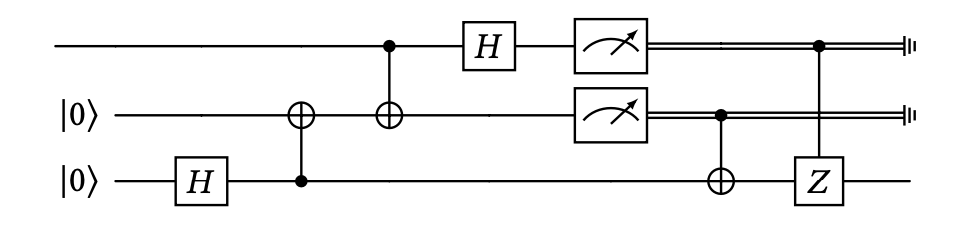
The size and shape of such a circuit determines whether it can be executed successfully by a given quantum architecture. For example, a circuit might be too wide (i.e. act on too many wires), and exceed the number of qubits in the architecture, or too deep (i.e. require many sequential operations), and exceed its coherence time. Furthermore, some architectures may deal poorly with a particular set of gates, or a specific wire type. All in all, keeping track of metrics such as circuit width or depth in a flexible and extensible manner is particularly desirable.
QuRA lets us to specify upper bounds on the size of the circuits built by programs by directly annotating their type. Let's revisit the teleportation example, focusing on circuit width. The circuit shown above has a width of 3, so we can annotate the type signature of teleport and its auxiliary functions accordingly:
-- teleportation-width.pq
-- put q and p into the entangled |+> state
bell ::  -o[2,0] (Qubit, Qubit))
bell (q, p) =
let q = (force hadamard @0) q in
let (q,p) = (force cnot @0 @0) q p in
(q,p)
-- Alice's part of the teleportation protocol
alice ::  -o[2,0] (Bit, Bit))
alice (p, r) =
let (r,p) = (force cnot @0 @0) r p in
let r = (force hadamard @0) r in
let c = (force meas @0) p in
let d = (force meas @0) r in
(c,d)
-- Bob's part of the teleportation protocol
bob ::  -o[3,0] Qubit)
bob (q, c, d) =
let (c,q) = (force ccnot @0 @0) c q in
let (d,q) = (force ccz @0 @0) d q in
let _ = (force cdiscard @0) c in
let _ = (force cdiscard @0) d in
q
-- teleport the state of qubit r (at depth i) into qubit q
teleport :: 
teleport r =
let q = force qinit0 in
let p = force qinit0 in
let (q,p) = force bell (q,p) in
let (c,d) = force alice (p,r) in
force bob (q,c,d)
The signature teleport :: !(Qubit -o Qubit) has become teleport :: , with the addition of three type annotations. In order of importance:
- The 3 in
-o[3,0]is the effect annotation of the function. It tells us thatteleportproduces a circuit of width at most 3 when applied. - The 0 in
-o[3,0]is the closure annotation of the function. It tells us that the data captured in the function's closure has a width of 0. This piece of information might seem exotic at first, but it is essential: in a language with first-class functions, a closure may very well capture variables with non-negligible size, such as qubits and bits. When that happens, the closure itself has a size, which must be recorded in order for the overall analysis to be sound. In our case, theteleportfunction is defined at the top level, so it cannot capture anything from the surrounding environment, let alone a qubit. - The 0 in
![0]tells us thatforceingteleportproduces a circuit of width 0. In other words, it tells us that no circuit is produced as a side-effect of forcingteleport.
The other signatures in the program are annotated in a similar way. Together, they tell us that bell and alice produce circuits of width at most 2, while bob and teleport produce circuits of width at most 3. By running QuRA with the -g width option, we can check that these upper bounds actually hold:
$ qura teleportation-width.pq -g width
Analyzing file 'teleportation-width.pq'.
Checked type, width.
...
teleport :: 
Note that by replacing -g width with -g gatecount we can verify the gate count of teleport, instead of its width. If we run this analysis on the same source code, however, we get the following error:
$ qura teleportation-width.pq -g gatecount
* Expected expression 'alice'
to have type
' -o[2, 0] (Bit, Bit))',
got
' -o[4, 0] (Bit, Bit))'
instead
This is because we are asking QuRA to verify that the circuit described by alice is made of at most 2 gates, which is simply untrue, as alice produces a 4-gate circuit (note that measurements count as gates). Luckily, QuRA is able to infer this and it suggests that alice should have type  -o[4, 0] (Bit, Bit)).
If we fix this and the remaining function signatures, we can verify the following gate counts for the teleportation functions:
$ qura teleportation-gatecount.pq -g gatecount
Analyzing file 'teleportation-gatecount.pq'.
Checked type, gate count.
bell ::  -o[2, 0] (Qubit, Qubit))
alice ::  -o[4, 0] (Bit, Bit))
bob ::  -o[2, 0] Qubit)
teleport :: 
Local metric analysis
In the previous examples, we used QuRA to verify the size of a circuit according to varying definitions of size. We call size metrics such as width and gate count global resource metrics, since they are properties of a circuit as a whole.
QuRA also lets us to verify properties of the individual wires within the circuit, that is, of the individual qubits and bits involved in the program. We call these properties local resource metrics. Depth is one such property, defined as the minimum number of execution steps required to produce a qubit, assuming that independent gates can be applied concurrently.
In order to specify an upper bound to the depth of the bits and qubits involved in the teleportation example, we no longer annotate arrow and bang types, but rather the wire types Qubit and Bit themselves, like this:
-- teleportation-depth.pq

-- put q and p into the entangled |+> state
bell :: !((Qubit{0}, Qubit{0}) -o (Qubit{2}, Qubit{2}))
bell (q, p) =
    let q = (force hadamard @0) q in
    let (q,p) = (force cnot @1 @0) q p in
    (q,p)

-- Alice's part of the teleportation protocol
alice :: !((Qubit{2}, Qubit{0}) -o (Bit{4}, Bit{5}))
alice (p, r) =
    let (r,p) = (force cnot @0 @2) r p in
    let r = (force hadamard @3) r in
    let c = (force meas @3) p in
    let d = (force meas @4) r in
    (c,d)

-- Bob's part of the teleportation protocol
bob :: !((Qubit{2}, Bit{4}, Bit{5}) -o Qubit{6})
bob (q, c, d) =
    let (c,q) = (force ccnot @4 @2) c q in
    let (d,q) = (force ccz @5 @5) d q in
    let _ = (force cdiscard @5) c  in
    let _ = (force cdiscard @6) d  in
    q

-- teleport the state of qubit r (at depth i) into qubit q
teleport :: !(Qubit{0} -o Qubit{6})
teleport r =
    let q = force qinit0 in
    let p = force qinit0 in
    let (q,p) = force bell (q,p) in
    let (c,d) = force alice (p,r) in
    force bob (q,c,d)
Local metric annotations are enclosed in curly braces, as opposed to square brackets, to better distinguish them from global metric annotations. You can see that the signature teleport :: !(Qubit -o Qubit) has become teleport :: !(Qubit{0} -o Qubit{6}), meaning that teleport takes as input a qubit at depth 0 and outputs a qubit at depth 6.
By invoking QuRA with the -l depth option, we can check that these upper bound is sound:
$ qura teleportation-depth.pq -l depth
Analyzing file 'teleportation-depth.pq'.
Checked type, depth.

...

teleport :: !(Qubit{0} -o Qubit{6})
Note that we now care about what index parameters we pass to library functions. These parameters specify the maximum depth at which the function can expect to find its qubit and bit arguments. This form of "local metric polymorphism" is essential, as it allows us to apply library operations to any qubit or bit, regardless of its depth.
For example, force hadamard @3 in the definition of alice can be applied succesfully to qubit r because the latter is at depth 3. If we changed force hadamard @3 to force hadamard @2, for instance, we would encounter the following error:
$ qura teleportation-depth.pq -l depth
* Expected expression 'r'
   to have type
    'Qubit{2}',
   got
    'Qubit{3}'
   instead
   ...
Dependent types
Naturally, local metric polymorphism is not only important for library functions. In fact, it would be good if our definition of teleport could also be applied to qubits at any depth. As it is currently defined, teleport can only be applied to inputs of type Qubit{0}, that is, to freshly initialized qubits. What if we needed to teleport a qubit after applying some operations to it? Tough luck! We'd have to write a new teleport which accepts qubits at the required depth.
In order to avoid this duplication, we can make teleport parametric in the depth of its input qubit. We do so by extending its definition with a new index parameter dr, which represents the maximum depth of the qubit r that we're teleporting:
-- teleportation-depth-generic.pq

-- put q and p into the entangled |+> state
bell :: !(forall dq. forall dp.
  (Qubit{dq}, Qubit{dp}) -o (Qubit{max(dq+1, dp) + 1}, Qubit{max(dq+1, dp) + 1}))
bell dq dp (q, p) =
    let q = (force hadamard @dq) q in
    let (q,p) = (force cnot @dq+1 @dp) q p in
    (q,p)

-- Alice's part of the teleportation protocol
alice :: !(forall dp. forall dr.
  (Qubit{dp}, Qubit{dr}) -o (Bit{max(dp, dr) + 2}, Bit{max(dp, dr) + 3}))
alice dp dr (p, r) =
    let (r,p) = (force cnot @dr @dp) r p in
    let r = (force hadamard @ max(dp, dr) + 1) r in
    let c = (force meas @ max(dp, dr) + 1) p in
    let d = (force meas @ max(dp, dr) + 2) r in
    (c,d)

-- Bob's part of the teleportation protocol
bob :: !(forall dq. forall dc. forall dd.
  (Qubit{dq}, Bit{dc}, Bit{dd}) -o Qubit{max(dd, max(dc, dq) + 1) + 1})
bob dq dc dd (q, c, d) =
    let (c,q) = (force ccnot @dc @dq) c q in
    let (d,q) = (force ccz @dd @ max(dc, dq) + 1) d q in
    let _ = (force cdiscard @ max(dc, dq) + 1) c  in
    let _ = (force cdiscard @ max(dd, max(dc, dq) + 1) + 1) d  in
    q

-- teleport the state of qubit r (at depth i) into qubit q
teleport :: !(forall dr. Qubit{dr} -o Qubit{dr+6})
teleport dr r =
    let q = force qinit0 in
    let p = force qinit0 in
    let (q,p) = (force bell @0 @0) (q,p) in
    let (c,d) = (force alice @2 @dr) (p,r) in
    (force bob @2 @ max(2, dr) + 2 @ max(2, dr) + 3)  (q,c,d)
Note that we extended the remaining function definitions in a similar way, introducing a new depth parameter for each qubit or bit input. The signature teleport :: !(forall dr. Qubit{dr} -o Qubit{dr+6}) tells us something more general than teleport :: !(Qubit{0} -o Qubit{6}): it tells us that for all dr, teleport takes as input a qubit at depth dr and outputs a qubit at depth dr+6. We call forall dr. Qubit{dr} -o Qubit{dr+6} a dependent type, since its precise meaning depends on the function parameter dr. Once again, QuRA can verify that the signature we gave for teleport actually holds:
qura teleportation-depth-generic.pq -l depth
Analyzing file 'teleportation-depth-generic.pq'.
Checked type, depth.

...

teleport :: !(forall dr. Qubit{dr} -o Qubit{dr + 6})
Circuit families
Dependent types are not only useful in local metric analysis. They become essential when describing and analyzing more complex quantum programs, which don't necessarily correspond to a single circuit.
The teleport function that we've seen so far always describes the same circuit, regardless of the value of dr. Verifying the size of such a circuit offers no real advantage: we could have simply applied teleport to any input, checked the resulting circuit, and directly computed its width, gate count, and depth instead of analyzing the source code.
Verification becomes essential when a PQ function describes a family of circuits, that is, different circuits depending on its input parameters. This is actually the case for most quantum programs, since quantum algorithms usually accept inputs of varying size and shape (e.g. quantum registers of any number of qubits), and one individual circuit isn't enough to deal with all of them. In this case, running the function on an arbitrary input and checking the size of the resulting circuit doesn't really tell us anything about the resource requirements of the program, but rather of only one run of the program.
An ubiquitous example of a quantum algorithm that corresponds to a circuit family is the quantum Fourier transform (QFT), which can be implemented in PQ as follows:
-- qft.pq

--- HELPER FUNCTIONS ---

-- invert the list of intermediate qubits at iteration iter
qrev :: !(forall iter. List[i<iter] Qubit -o List[i<iter] Qubit)
qrev iter reg =
    let revStep = lift forall step.
      \(rev, q) :: (List[i<step] Qubit, Qubit).
        rev:q in
    fold(revStep, [], reg)

-- apply the controlled rotation gate to the target qubit trg at iteration iter
rotate :: !(forall iter. !(forall step.
  ((List[i < step] Qubit, Qubit), Qubit) -o (List[i < step + 1] Qubit, Qubit)))
rotate iter = lift forall step.
  \((ctrls, trg), ctrl)::((List[i<step] Qubit, Qubit), Qubit).
    let (ctrl, trg) = (force cr @(iter+1-step) @0 @0) ctrl trg in
    (ctrls:ctrl, trg)

--- QUANTUM FOURIER TRANSFORM ---

qftIteration :: !(forall iter. (List[i<iter] Qubit, Qubit) -o List[i<iter+1] Qubit)
qftIteration iter (ctrls, trg) =
    let revctrls = (force qrev @iter) ctrls in
    let (ctrls, trg) = fold(force rotate @iter, ([], trg), revctrls) in
    let trg = (force hadamard @0) trg in
    ctrls:trg

-- apply the Quantum Fourier Transform to n qubits at depth d
qft :: !(forall n. List[i<n] Qubit -o List[i<n] Qubit)
qft n reg = fold(qftIteration, [], reg)
The signature qft :: !(forall n. List[i<n] Qubit -o List[i<n] Qubit) tells us that qft is a function that, for all n, takes as input a list of n qubits and outputs a list of the same length.
In this signature we encounter a new kind of annotated type, the sized dependent list type. A type like List[i<n] Qubit represents a list of exactly n qubits. The elements of the list may have a type that depends on i, which ranges from 0 (included) to n (excluded) and represents the position of the element within the list. In this case, Qubit doesn't depend on i, but dependency is useful when we are working with nested lists or resource-annotated types. For example, List[i<n] List[j<i] Qubit is a list of n lists of qubits, where the i-th list has length i. Similarly, List[i<n] Qubit{i} is a list of n qubits where the i-th qubit sits at depth i.
Notice that whereas the index parameters that we've encountered in the teleportation examples are only used for verification, and thus are ignored at runtime, the n parameter in the definition of qft has a profound impact on the circuit described by the function: qft @1 accepts an input of type List[i<1] Qubit, and thus corresponds to a circuit with only one input. qft @2 is a circuit with 2 inputs, while qft @10 a circuit with 10 inputs, and so on.
Naturally, any form of size or depth analysis of qft must take n into account, and reasonably produce upper bounds on the size of the circuit that are parametric in n. For example, we can verify the width of qft as follows:
-- qft-width.pq
--- HELPER FUNCTIONS ---
-- invert the list of intermediate qubits at iteration iter
qrev :: 
qrev iter reg =
let revStep = lift forall step.
\(rev, q) :: (List[i<step] Qubit, Qubit).
rev:q in
fold(revStep, [], reg)
-- apply the controlled rotation gate to the target qubit trg at iteration iter
rotate :: , Qubit) -o[step+2,0] (List[i<step+1] Qubit, Qubit)))
rotate iter = lift forall step.
\((ctrls, trg), ctrl)::((List[i<step] Qubit, Qubit), Qubit).
let (ctrl, trg) = (force cr @(iter+1-step) @0 @0) ctrl trg in
(ctrls:ctrl, trg)
--- QUANTUM FOURIER TRANSFORM ---
qftIteration ::  -o[iter+1,0] List[i<iter+1] Qubit)
qftIteration iter (ctrls, trg) =
let revctrls = (force qrev @iter) ctrls in
let (ctrls, trg) = fold(force rotate @iter, ([], trg), revctrls) in
let trg = (force hadamard @0) trg in
ctrls:trg
-- apply the Quantum Fourier Transform to n qubits at depth d
qft :: 
qft n reg = fold(qftIteration, [], reg)
The signature qft :: !(forall n. List[i<n] Qubit -o List[i<n] Qubit) becomes qft :: , telling us that, for all n, qft takes as input a list of n qubits and outputs a list of n qubits, describing a circuit of width at most n.
Note that the forall[0,0] type is annotated the same way as the linear arrow -o. This is because, at the fundamental level, both represent functions: whereas a -o b represents a linear function from values of type a to values of type b, the type forall i. c represents a function from indices to values of type c. The only real difference is that c is allowed to depend on the i parameter, whereas b cannot depend on function's parameter of type a. This limitation to dependency ensures that inference remains decidable in QuRA.